Better, Safer, Faster, Cheaper: AI’s impact on drug design
What is the ROI of AI-driven drug discovery? Pharma R&D burns roughly $300 billion a year, about $6 billion per approved drug. AI today primarily impacts the speed at which drugs are developed, but today's models barely move the needle. Here we demonstrate that, if AI matures further through advancements in models and data, we can expect to reduce the cost per approved drug by ~50%, doubling R&D productivity and transforming the economics of drug discovery.
The costs of drug discovery
Over the past five years, biopharma spent ~$300 billion on R&D annually [1], while the FDA approved an average of roughly 50 novel drugs per year over 2021–2025 [2], implying roughly $6 billion of R&D per new drug. Discovery work such as hit identification, lead optimisation, and preclinical studies accounts for ~46% of pharma R&D [3], putting preclinical drug design spend at ~$2.8 billion per approved drug. This figure covers multiple preclinical candidate (PCC) nominations, chemistry, assays, staff, M&A, and overheads.
How much value could AI generate in theory?
For this thought experiment, suppose AI could instantly deliver hits (molecules that show early promise against a disease target), and then, within a few design cycles, generate the perfect preclinical candidate: with great potency, safety, and drug-like properties.
Even in this dream case, assay noise and other irreducible factors would likely still require at least a few months of design work. Additionally, there is likely an incompressible floor of 6 months of preclinical work before one can dose the first patient. So instead of the industry average of ~60 months from target to clinic [3], we would likely be able to get into Phase 1 trial with ~10 months of work, 17% of the original time, saving approximately $2.3 billion in value per approved drug.
Another hypothetical effect of AI could be improved drug quality due to better safety: better-optimised drugs could plausibly reduce safety failures in Phase 1 clinical trials as they can be dosed at a lower concentration. In Waring et al.'s [4] analysis of 605 drug candidates from AstraZeneca, Eli Lilly, GSK, and Pfizer, safety and toxicology accounted for roughly 39% of Phase 1 failures. Assuming that, in an ideal world, we could address the whole 39% with better-chosen candidates, and that drugs fail Phase 1 with a likelihood of 46% [4], AI would then yield an 18% gain in Phase 1 success. Against a 54% baseline success rate [3], we would reach 72%. The main effect is a 25% reduction in spend on everything before Phase 1, since it becomes less likely that another PCC must be nominated. Pre-Phase 1 activities make up 33% of the overall drug budget [3], giving a potential value of $0.5 billion — much smaller than the cost savings effect.
Combining speed to clinic, speed to market and improved quality, we can hypothesise a total value potential of $2.8 billion per approved drug; a ~2× productivity improvement for pharma R&D that would reshape the economics of drug discovery.
Linking AI performance to productivity impact
Having dreamt the ideal case, where are we today and how much further do we need to go?
We assume a program reaches its development candidate once a compound passes the target product profile — good binding, good PK, and low tox — and that such compounds occur at roughly 1 in 1,000. Roughly 1% of Enamine REAL, a large commercial library of drug-like molecules, has a Quantitative Estimate of Druglikeness (QED) above 0.7 (a 0–1 score combining molecular weight, lipophilicity, hydrogen-bonding and ring count). The joint binding-plus-PK-plus-Tox constraint trims that by roughly another order of magnitude. This is also consistent with the observed 1,000–2,000-compound industry baseline [7].
To estimate today’s AI performance, we use published benchmarks. The ExpansionRx OpenADMET blind challenge evaluated several global absorption, distribution, metabolism and excretion (ADME) models on a held-out dataset from Expansion Therapeutics [5], with the best average model reaching a macro-mean Spearman correlation of about 0.49 across four ADME endpoints (LogD, Caco-2 apparent permeability (A→B), hepatic microsomal clearance, and mouse plasma protein binding). Spearman ρ measures rank-order agreement between predicted and measured values, ranging from 0 to 1, where 0 is random and 1 is a perfect ranking. For binding affinity, physics-based free-energy perturbation (FEP+), still the state of the art in binding predictions, achieves a comparable Spearman of ~0.55 on standard congeneric-series benchmarks [6]. Combining four ADME endpoints with one binding endpoint gives a composite macro-mean Spearman of 0.50: a 67% pairwise ranking accuracy, 17 percentage points above a coin flip. Here we consider that 67% is the baseline pairwise ranking capability that anyone in theory has access to and which thus corresponds to the observed 60-month industry average. This is of course a crude assumption as many labs may not even have access to industry standards so we may be overestimating the impact AI already has.
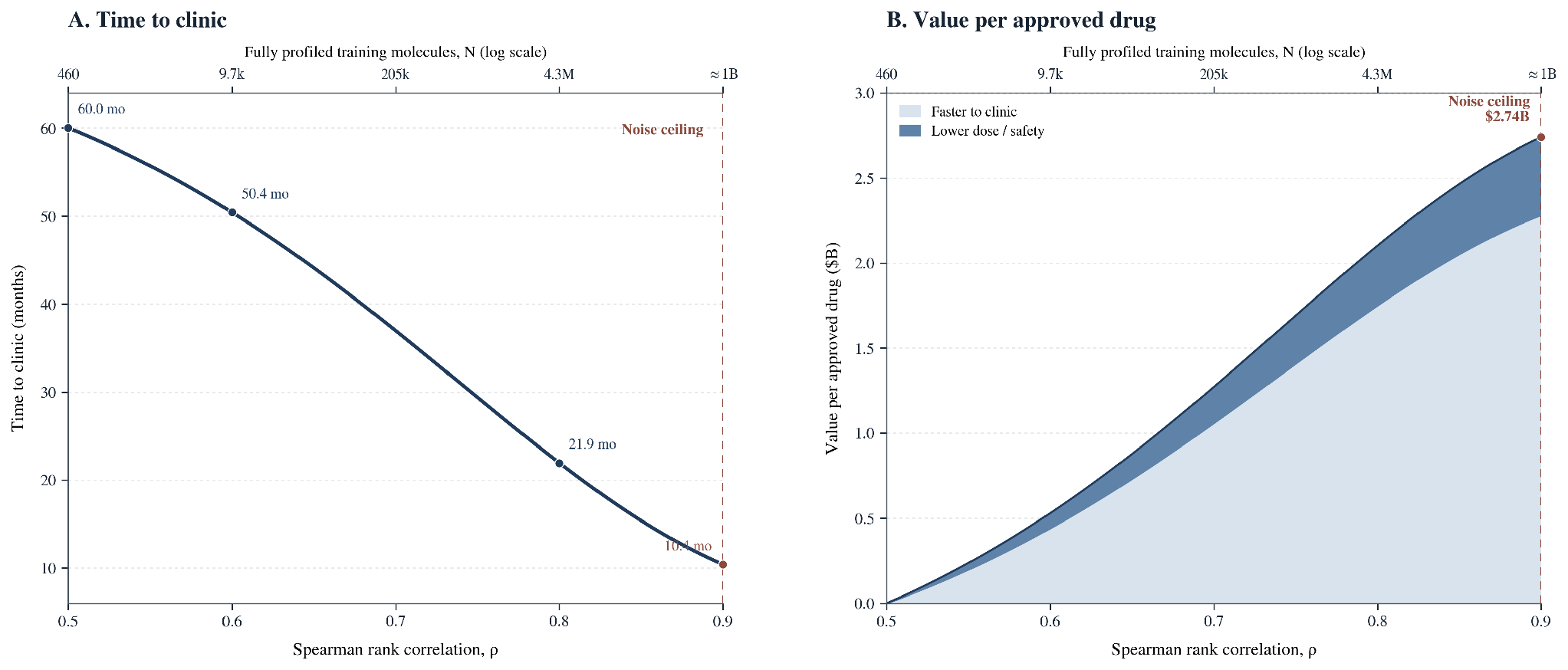
By how much AI speeds up drug discovery can be expressed in terms of ranking accuracy. For simplicity, we assume that we want to retain 99% of profile-passers, which as described above occur at a rate of 1 in 1,000. At 71% AI accuracy (ρ ≈ 0.60) one gets into the clinic in ~50 months. If we can one day build models with 87% pairwise ranking capability (ρ ≈ 0.90) we could get there in less than 12 months (Figure Panel A).
With these crude assumptions and an assay noise ceiling at ρ ≈ 0.90 the maximum value that AI can deliver per approved drug is roughly $2.7 billion, similar to the estimate we made earlier (Figure Panel B). But performance of today's models is still a far cry from what is needed. Hence investing in the performance of AI models for molecular properties may transform R&D productivity.
There are further effects, deliberately left out of this analysis, that are worth considering. For example, better predictions, and better AI-generated molecules, should raise the odds of nominating a candidate at all. Some of this is implicit in the screening-efficiency story above: programs that currently fail because they exhaust their budget before finding a candidate are converted to successes by better AI. But better predictors also rescue programs killed by misleading structure–activity relationships (how small chemical changes shift a molecule's behaviour), and open regions of chemical space that today’s tools cannot navigate, such as where many goals must be met at once, with binding, absorption, safety, and selectivity reconciled simultaneously. Even a modest lift from, say, 40% to 50% in the probability of reaching PCC nomination translates into 25% more candidates entering the clinic per dollar of discovery spend, multiplying directly through the rest of the funnel.
For decades, drug discovery has scaled by spending more; the next decade will scale by predicting better. The teams that build the most accurate models, on the back of more and better data, won't just design molecules faster; they'll rewrite the economics of the whole industry.
Methods
- Profile-passer prevalence. We assume profile-passers (good binding, good PK, low tox) occur at ~1 in 1,000 within a drug-like designed pool. This is anchored to two data points: ~1% of Enamine REAL passes QED > 0.7, and the joint binding-plus-PK-plus-Tox constraint trims that by roughly another order of magnitude.
- Baseline model accuracy proxy for “today’s models”. We take the leading public predictor accuracy on novel chemical space as the baseline. ADME: OpenADMET blind-challenge best model, macro-mean Spearman ρ ≈ 0.49 across four endpoints (5). Binding: FEP+ on congeneric series, Spearman ρ ≈ 0.55 (6). Composite (four ADME + one binding, equal weight) ρ = 0.50, which under a bivariate-normal model corresponds to 67% pairwise ranking accuracy. We convert Spearman ρ to Pearson r via r = 2 sin(πρ/6) (the closed-form relation for bivariate-normal data), then to pairwise concordance via P(correct) = ½ + arcsin(r)/π. Real ADMET endpoints are often censored or log-bounded and depart from bivariate normality; the resulting pairwise-accuracy figures are therefore approximate, but the qualitative ranking and the order-of-magnitude value claims are robust to that approximation. The composite ρ = 0.50 gives r ≈ 0.52 and P(correct) ≈ 0.673, rounded to 67%.
- Selection fraction. Given a bivariate-normal joint distribution of model score and true property with correlation ρ, we compute the fraction of the top-ranked designed pool a team must synthesise to retain 99% of profile-passers (top 0.1% of the truth distribution). Closed-form via the bivariate normal CDF.
Acknowledgements
Thanks to Mark Murcko, Pat Walters, and the deepmirror team for thoughtful feedback and reading recommendations.
References
- European Commission, Joint Research Centre. The 2025 EU Industrial R&D Investment Scoreboard. https://iri.jrc.ec.europa.eu/scoreboard/2025-eu-industrial-rd-investment-scoreboard
- U.S. Food and Drug Administration. Novel Drug Approvals for 2025. https://www.fda.gov/drugs/novel-drug-approvals-fda/novel-drug-approvals-2025
- Paul, S. M. et al. How to improve R&D productivity: the pharmaceutical industry's grand challenge. Nat. Rev. Drug Discov. 9, 203–214 (2010).
- Waring, M. J. et al. An analysis of the attrition of drug candidates from four major pharmaceutical companies. Nat. Rev. Drug Discov. 14, 475–486 (2015). https://www.nature.com/articles/nrd4609
- Castellanos, M. & MacDermott-Opeskin, H. Lessons Learned from the OpenADMET-ExpansionRx Blind Challenge: Can We Trust Zero-Shot ADMET Predictions? openadmet.ghost.io/zero-shot-expansiorx-admet-predictions/, visited on 20 May 2026 (2026).
- Wang, L. et al. Accurate and reliable prediction of relative ligand binding potency in prospective drug discovery by way of a modern free-energy calculation protocol and force field. J. Am. Chem. Soc. 137, 2695–2703 (2015).
- Retchin, M., Wang, Y., Takaba, K. & Chodera, J. D. DrugGym: A testbed for the economics of autonomous drug discovery. bioRxiv 2024.05.28.596296 (2024).